 Back

Raiffeisen Leasing
Case study
Simplifying the journey from an initial calculation to contract closure
Project & role
Raiffeisen Leasing Online (RLO) is the company’s in-house platform for the full leasing lifecycle. It connects internal teams, business clients and a network of brokers, dealers, suppliers and insurers. At the time of the project, Raiffeisen Leasing managed a €600M corporate leasing portfolio.
From 2021 to 2024, I worked on RLO as Lead Product Designer, conducting research and designing workflows from the first calculation to contract closure. I also led a group of designers across CIB (Corporate & Investment Banking) product teams. I worked with the Product Owner and colleagues in Engineering, Business, Sales and Operations.

The challenge
Managers manually gathered deal data, compared supplier and insurer offers, calculated leasing terms and uploaded the completed commercial proposal to RLO as a document. Some calculations stayed in their own Excel spreadsheets, leaving potential deals unrecorded in the system. Business feedback and funnel data confirmed the problem.
Vendor limitations led the company to develop its own ecosystem. The goal was to scale leasing through partners and reduce manual processing. We started with proposal preparation so managers could discuss terms and move agreed options forward faster.
According to the company’s 2023 presentation, brokers accounted for 70% of new business in its retail leasing segment in Q1 2022.
Research & process
I interviewed managers, insurance and compliance specialists and reviewed the existing BPMN diagram. I then validated hypotheses and refined the workflows through several usability tests with managers.
Interviews and usability tests helped us identify which data was needed for the first calculation and which could be requested later. The initial step required the client’s tax ID, asset cost, term, advance payment and other calculation inputs. Documents and insurance details were collected at later stages, when checks and financing approval also took place. This allowed managers to discuss terms with clients sooner.
The solution
Creating and exploring proposals in RLO
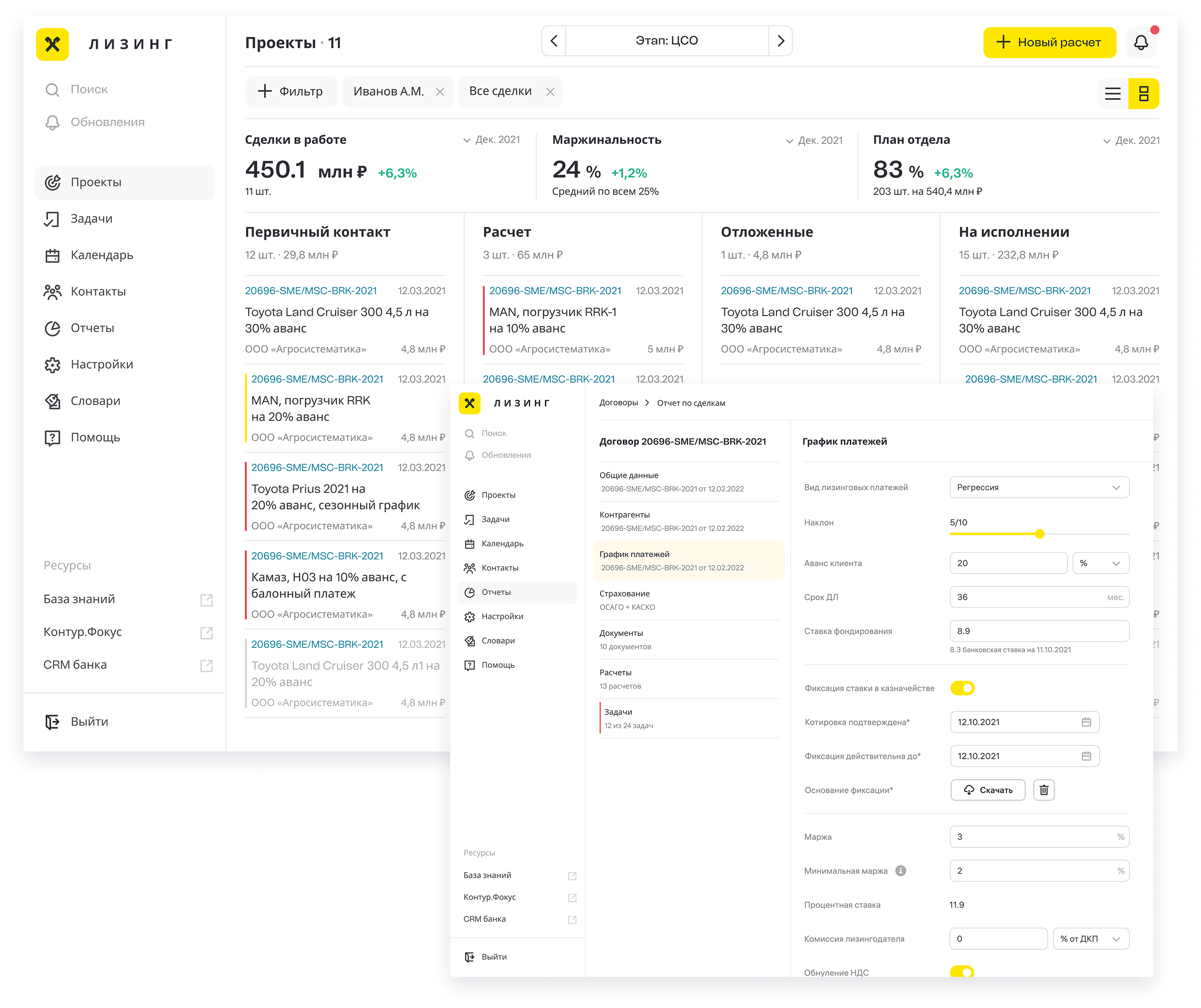
Managers created commercial proposals with indicative calculations in RLO, discussed them with clients and quickly prepared alternatives when needed. Once an option was agreed, they initiated the next deal stage and the system routed the proposal through the configured workflow. Indicative calculations helped clients assess terms without being a binding offer or final financing approval. Tax-ID scoring informed the available terms.
Connecting the full lifecycle
I designed workflows across the full leasing lifecycle:
- Document collection, compliance and security checks, insurance, financing approvals and contract preparation.
- After signing, payment servicing through the final instalment, contract closure and asset buyout.
- Overdue payments, asset repossession and asset loss.
- Changes of insurer or lessee, and changes to the legal entity.
Supporting flexible payment schedules
Managers previously had to complete most of the flow, then edit the payment schedule in PDF or Excel, leaving the proposal out of sync with RLO. I moved these edits to proposal preparation and linked two views: deal parameters and an automatically calculated schedule that could be tailored to the client. Changes to the schedule updated deal parameters, and vice versa. It supported a range of schedules, including balloon, increasing, decreasing and seasonal payments.
Extending self-service to clients and partners
B2B clients could track statuses, upload documents, view contracts and payment schedules, obtain documents for active contracts and receive electronic status notifications.
I improved existing dealer and supplier applications, calculations and tracking. Dealers automatically received indicative calculations without waiting for a manager. Applications followed a separate business process before reaching a manager for processing.
Outcomes
- Managers’ preparation time for a commercial proposal with an indicative calculation fell from 12 to 2 minutes.
- Conversion from “proposal received” to “proposal in progress” increased by 20 percentage points.
- Dealers received indicative calculations within minutes instead of waiting up to a day for manual processing.
- Managers recorded deals in RLO more often and relied less on their own Excel spreadsheets.
- The wider product effort expanded automation from proposal preparation through contract servicing and closure.
- During product development, NPS improved, with manager and client scores analysed separately. The team later shifted from measuring loyalty through NPS to measuring product satisfaction through CSAT. Specific scores are confidential.
Team feedback
He always keeps user in mind while proposing new design. Dmitry has great experience in different products that he uses to develop the best possible solution…
Dmitry is a professional designer with high standards of performance. He always keeps user in mind while proposing new design. Dmitry has great experience in different products that he uses to develop the best possible solution…

Dmitry is almost the only one who tries to deep into the business processes, financial model, stakeholders’ views and other business aspects of the product…
I have worked with many designers and I want to mention that Dmitry is almost the only one who tries to deep into the business processes, financial model, stakeholders’ views and other business aspects of the product…

He successfully demonstrated a wide range of capabilities: from developing existing products to launching new services from scratch…
He successfully demonstrated a wide range of capabilities: from developing existing products to launching new services from scratch. He offered fresh conceptual design solutions and scalable approaches…

Dmitriy consistently brings a unique perspective to product, offering unconventional solutions to achieve the desired goal

Behind the scenes
Design leadership
Alongside leasing work, I led a group of designers across CIB product teams, supported hiring and ran design reviews and one-on-ones. I helped with complex scenarios, design-system consistency, professional development and public speaking.
Ways of working
I helped apply an adapted Triple Diamond process, shape the design roadmap and work with business stakeholders. Problem exploration, hypothesis testing and early discussions with the business helped reduce rework.
Designing LaaS from scratch
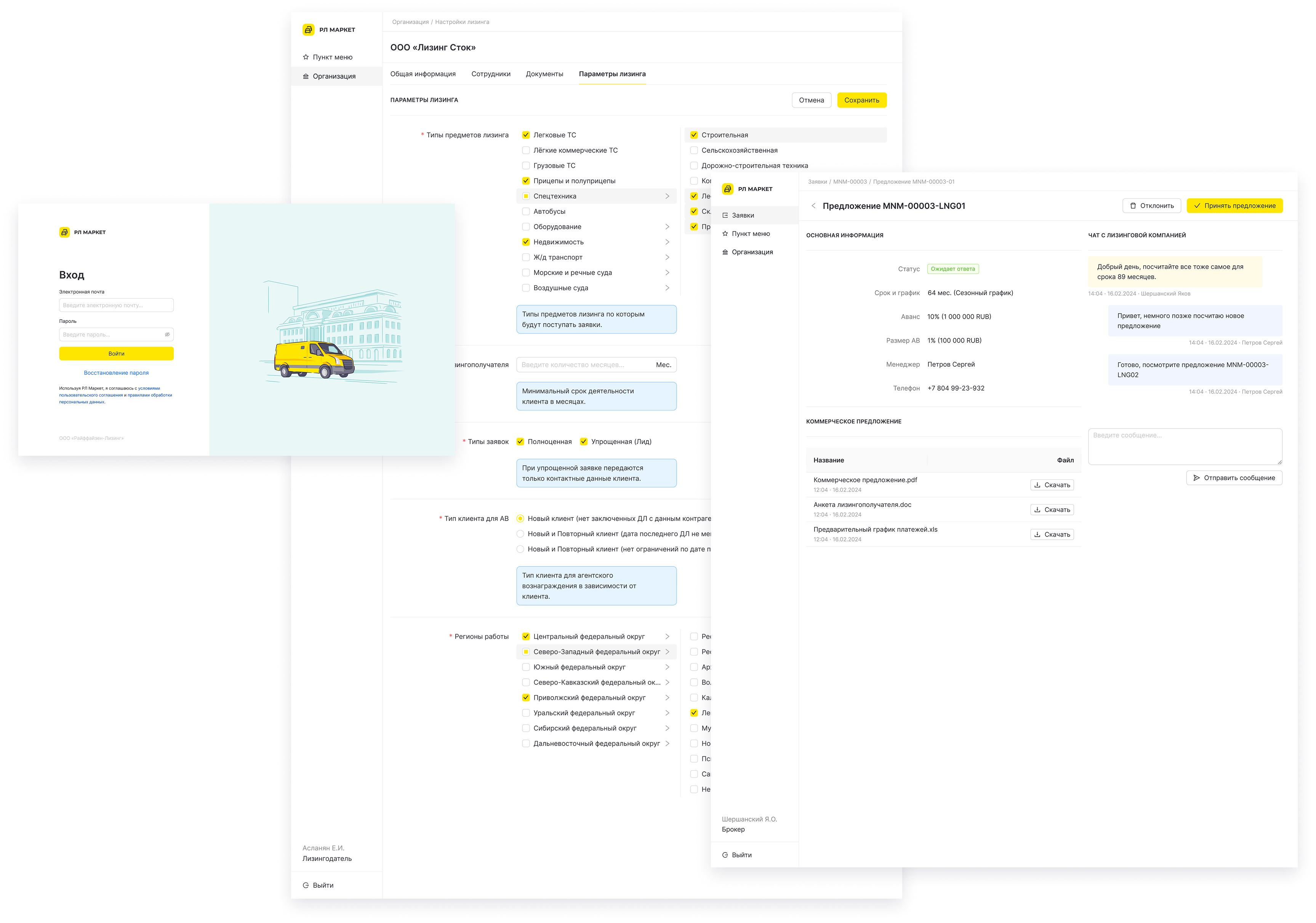
I designed LaaS (Leasing as a Service), a B2B marketplace for collaboration between brokers and leasing companies, from scratch.
AI-assisted offer analysis
I designed AI assistant workflows for comparing supplier, insurer and competing leasing-company offers. The assistant highlighted differences in terms and helped managers prepare a more favourable offer for the client.


