 Back

Larixon Classifieds
Case study
Building a design function across markets and product teams
Project & role
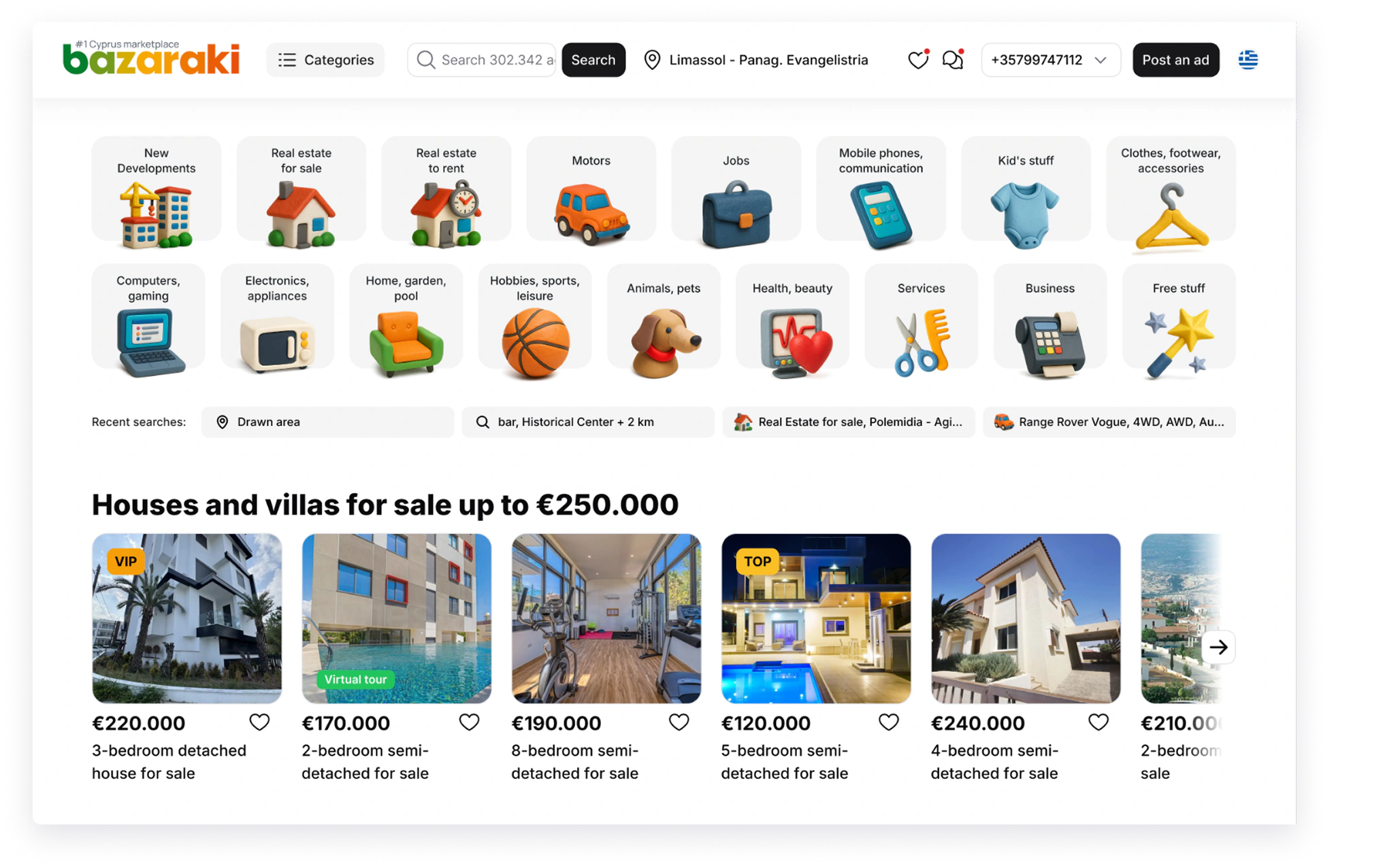
Larixon operates a group of classifieds platforms across five markets, with a shared web and app core and around 5M monthly active users. Its products include market-leading classifieds platforms: Bazaraki (Cyprus), Unegui (Mongolia) and Somon (Tajikistan).
As Design Lead, I led seven Product Designers and a UX Research Lead across 8+ product verticals. I was responsible for Product Design, UX Research, DesignOps and Design Systems, reporting directly to the CPO.
The challenge
Previously, design work at the company was largely reactive: teams received requests and produced screens. There was no design system, and shared processes, quality standards and a research function had not been established.
Tasks could arrive without business goals, analytics or success criteria. Designers spent time clarifying requirements, while stakeholders lacked visibility.
The brief was to build a design function across product teams, align its priorities with the business and create a design system for web and app.
Team feedback
He is a reliable and well-organized professional who manages his work with discipline and attention to detail…
He is a reliable and well-organized professional who manages his work with discipline and attention to detail. At the same time, he actively listens to different perspectives and adapts his approach to support each team member…
Instead of just managing people, he restructured the whole team into product verticals, which made scaling a lot smoother…
He brought much-needed clarity by defining specific roles and setting strict rules for task inputs and design outputs. Instead of just managing people, he restructured the whole team into product verticals, which made scaling a lot smoother…
From the very beginning, communication was always clear, structured, and respectful, which created a strong sense of trust and stability in everyday work…
Working with Dima was genuinely one of the most comfortable and positive professional experiences I’ve had. From the very beginning, communication was always clear, structured, and respectful, which created a strong sense of trust and stability in everyday work…

Dmitry is simply a great person to work with. He built a team environment where designers felt supported and could discuss challenges openly…
Beyond the professional side, Dmitry is simply a great person to work with. He built a team environment where designers felt supported and could discuss challenges openly without unnecessary pressure…
Research & process
Through a maturity matrix, interviews and workflow analysis, I identified the causes of delays: no Definition of Ready, unclear responsibilities and a lack of pairing between designers and Product Owners. Designers lacked focus, and tasks accumulated in queues and took longer to complete. These findings informed the process changes.
From these findings, I developed a strategy and quarterly plan. I discussed them with the CPO and CEO, iterated on their feedback and connected the proposed changes to the needs of product teams. I worked through cross-team process changes with PMs, Product Owners, the QA Lead and Frontend Lead.
The solution
A design system for web and app
I built a new design system using shadcn/ui as its foundation, which helped us put tokens and reusable components in place faster. I appointed Design System Owners, established contribution rules and introduced a tracker for component readiness in Figma, code and production. I implemented Figma Code Connect.
DesignOps
I introduced OKRs, regular reviews and visibility of design work in Jira. Through a Design Definition of Ready (dDOR), I set requirements for incoming tasks: context, goals, data, constraints and acceptance criteria.
Working with the team
I introduced regular one-on-ones, design reviews and design-team retrospectives.
UX Research
I hired a UX Research Lead to own the function and established touchpoints in the product process, Russian and English templates, and a research repository in Airtable.
Hiring and team development
I hired Product Designers for Jobs, Local Markets and Real Estate and assigned design coverage across product verticals. I introduced whiteboard interviews and hiring scorecards, alongside onboarding, buddy support, one-on-ones, competency assessments and individual development plans.
Outcomes
- The full design-system component library is now in production.
- The cycle from task briefing to completed design fell to three weeks; previously, it could stretch over several months.
- UX Research became a regular part of product development, helping teams make decisions across verticals and markets.
- The design function gained defined owners, shared working practices and transparent planning.
Behind the scenes
I developed AI-assisted workflows, ran a workshop and piloted a Claude plugin for the design process. I also built a Figma plugin for checking translations and text length, and launched a Smartcat localisation pilot.


